The FHL Tax Cliff:
How UK Holiday Let Hosts
Can Recover Lost Income in 2026
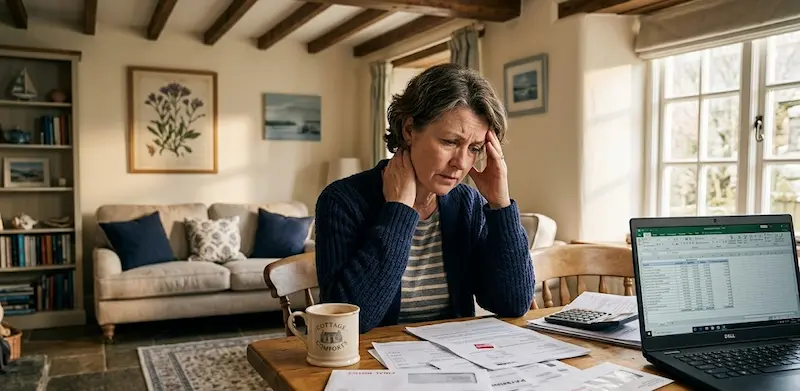
There was a moment, sometime in April 2025, when a great many UK holiday let owners sat down with their accountants and felt the ground shift. The Furnished Holiday Lettings tax regime — a framework that had supported short-term rental businesses since 1982 — was gone. The rules that had made a holiday let a tax-efficient investment for thousands of hosts across England, Wales and Scotland were replaced, almost overnight, with something considerably less generous.
If you are one of those hosts, you already know the numbers. But knowing the numbers does not make them easier to absorb. The question that follows — how do I make this work now? — is not well answered by most of the advice available online, which tends to focus on tax restructuring rather than on what you can actually do to your property to earn more from it. This guide is about the revenue side of that question.
What the abolition actually removed
The FHL regime was abolished on 6 April 2025, following its announcement in the Spring 2024 Budget. The government estimated it would raise £35 million in its first year, rising to £245 million annually by 2028/29. Every penny of that comes from holiday let owners in the form of higher tax bills. Understanding exactly where those bills come from is essential before you can calculate what recovery looks like.
Mortgage interest relief
Under the old regime, you could deduct the full cost of your mortgage interest from your rental income before calculating your tax liability. This was particularly valuable for higher-rate taxpayers, who could effectively claim 40% or 45% relief on their interest costs. From April 2025, you can only claim a 20% tax credit — the same arrangement that already applied to long-term residential landlords. For a higher-rate taxpayer with a £150,000 interest-only mortgage at a 5% rate, the annual interest cost is £7,500. Under the old system, that reduced their tax bill by £3,000. Under the new system, it reduces their bill by £1,500. That single change costs £1,500 per year in additional tax.
Capital allowances on furnishings
Previously, holiday let owners could claim capital allowances on new fixtures, furniture and furnishings as business expenditure — including items purchased for the first time. From April 2025, you can only claim Replacement of Domestic Items Relief, which applies when you replace an existing item rather than buying something new. A host refurbishing a room from scratch can no longer claim relief on new furniture and fittings. The effective cost of investing in your property has increased, and the tax incentive to improve the physical quality of your space has been materially reduced.
Capital Gains Tax reliefs
Business Asset Disposal Relief, which allowed qualifying FHL owners to pay just 10% CGT on the first £1 million of gains on a sale, is no longer available. Rollover Relief — which allowed you to defer a gain by reinvesting in a replacement business asset — has also gone. For hosts who were planning to sell and reinvest, the tax landscape has changed considerably and specialist advice is essential before making any decisions.
“The FHL abolition is, in a strange way, a clarifying event. It removes a financial subsidy that was partly masking the difference between a well-presented property and a mediocre one.”
The recovery maths: why the nightly rate is your lever
Tax planning — reviewing your structure, consulting a specialist, exploring pension contributions — is worth doing. But it is a cost-reduction exercise. It limits the damage; it cannot replace the income you have lost. The only way to actually recover lost income is to earn more of it. For a holiday let, that means either more booked nights or a higher nightly rate.
In a market where supply has grown faster than demand, adding availability is not a reliable strategy on its own. The more direct lever is the rate. If the FHL changes cost you an additional £1,500 a year in tax, you need to earn an extra £1,500 in revenue to break even. Over 150 booked nights, that is £10 more per night. Over 100 nights, it is £15 more. These are not large increases in absolute terms. But they require guests, when comparing your listing to the alternatives, to believe your room is worth that premium.
That belief is not manufactured by price alone. It is earned by what the room looks like, how it makes guests feel, and whether it offers something specific and memorable that the alternatives do not. A room that could be anywhere — pleasant, clean, entirely without character — will find it very hard to justify a premium in a crowded market. A room with a clear identity and a coherent sense of place is a room that can hold a premium with confidence.
What guests actually pay more for
The question of what drives willingness to pay a higher nightly rate is well studied in hospitality research, and the findings are consistent: guests pay more for rooms that feel intentional. Not expensive. Not designer-led. Intentional — which means every element of the room suggests that someone thought carefully about what the space was trying to be and made choices accordingly.
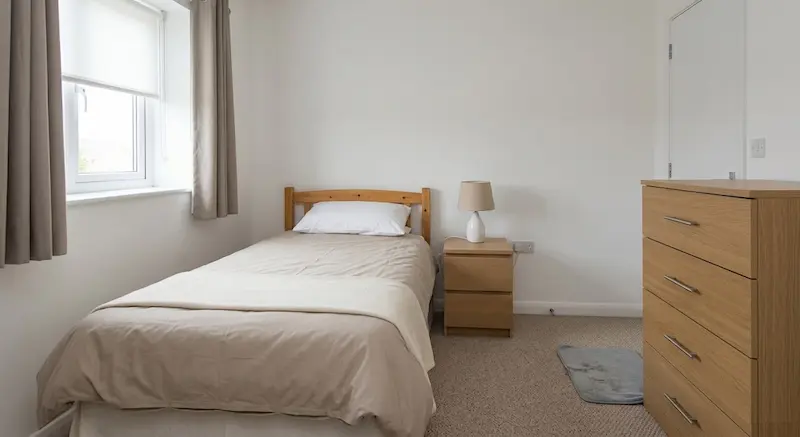
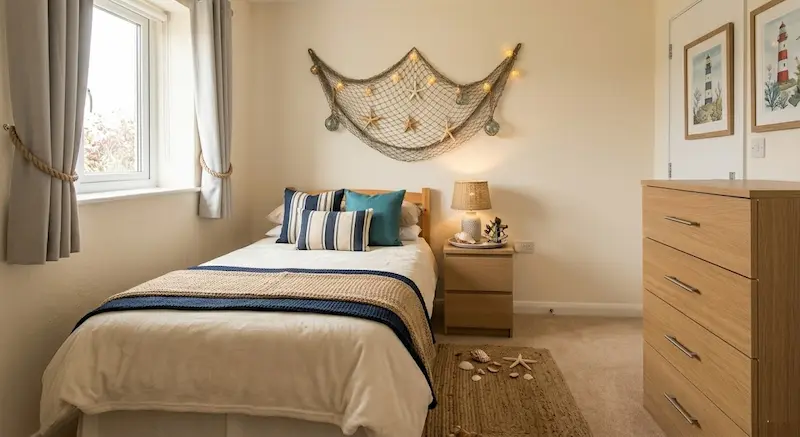
A coastal room where the cushions, the wall feature, the rug and the small details all tell the same story gives a guest something to name. “We stayed in this gorgeous coastal room,” they will tell a friend. “It had this fishing net on the wall with starfish woven through it, and everything just felt like the seaside.” That description has specificity. It is memorable because it is specific, and it is specific because the room had an identity. A room with cream walls and neutral furnishings gives a guest nothing to name — and nothing to share, nothing to recommend, and no emotional reason to pay more than the cheapest comparable option in the search results.
VisitEngland’s quality assessment framework has a formal criterion for exactly this. It is called Sense of Place, and it asks assessors to consider whether a property feels connected to its location, its character, and its story. What VisitEngland’s Sense of Place criteria actually require is not a major renovation — it is a coherent decorative identity. Properties that achieve this tend to score higher in assessments, attract less price-sensitive guests, and maintain stronger occupancy when markets soften.
Three things that justify a higher rate
1. A hero photo that stops the scroll
The listing photo is the moment of decision for most guests. Research consistently shows that listing quality — led by the main photo — is the primary determinant of click-through rate before price, reviews or location are even considered. A room with a clear visual identity stops the scroll. A room that looks like every other room on the platform does not. Our guide to better Airbnb photos covers what the hero image needs to communicate and how to ensure yours is doing it effectively.
2. A memorable arrival moment
Guests remember stays through what psychologists call the peak-end rule: the emotional peak and the ending are what encode in memory, not the average quality of the hours in between. For a holiday let, the peak is most likely to occur at arrival — the moment the guest opens the room door and sees it for the first time. A room that communicates something immediately creates that peak at the very start of the stay. A generic room creates no peak at all, which is why guests who enjoyed a perfectly comfortable stay so often do not return: there was nothing specific enough to remember, and therefore nothing to bring them back.
3. Details that earn a description
The specific decorative details most likely to be photographed, described and shared are those that feel particular rather than generic. A fishing net on the wall with starfish woven through it. Coordinated nautical cushion covers on the bed. A coastal bedside rug that ties the floor to everything above it. These details do two things simultaneously: they create the visual hook that makes your listing photo stand out, and they give guests the specific vocabulary to describe their stay to others. That word-of-mouth effect — “you have to stay in this coastal room, it’s gorgeous” — is the highest-value marketing a holiday let can generate, and it cannot be bought with a dynamic pricing tool.
The revenue calculation over a full year
The average UK holiday let earns around £24,700 per year, according to industry data from Sykes Cottages and Beyond Pricing, though this figure masks significant variation by location, size and presentation quality. The gap between a well-presented and a poorly-presented property in the same postcode is typically not explained by location or bedroom count — it is explained by the nightly rate that can be sustained and the occupancy level that can be maintained over a full season.
Our detailed analysis in the hidden cost of a generic BnB room works through the full revenue calculation. The summary: a £10 nightly rate premium over 150 booked nights is £1,500 per year. A £15 premium over the same nights is £2,250. Both are sufficient to offset the FHL tax losses for most affected hosts. The investment required to achieve and hold that premium — a coordinated themed decoration kit for £79 — is recovered in the first week of higher rates.
The compounding effect over time is also worth noting. A room that commands a higher rate does so not just because of how it looks, but because of the reviews it generates and the guests it attracts. Higher-rate guests tend to be less price-sensitive, more likely to leave detailed positive reviews, and more likely to return. Each outcome further reinforces the ability to hold the rate, creating a virtuous cycle that a generic room, trapped in a race to the bottom on price, cannot access. Our guide on five low-cost ways to increase your nightly rate covers the practical steps in detail.
Which hosts are most affected
The impact of the FHL abolition is not uniform. It falls most heavily on three groups. The first is higher-rate taxpayers with mortgaged properties, for whom the loss of full mortgage interest relief is the most financially significant change. The second is hosts who were planning to invest in their properties through new fixtures and furnishings, and who now face less favourable tax treatment on that investment. The third is hosts approaching a sale, for whom the loss of Business Asset Disposal Relief materially changes the after-tax proceeds from any transaction.
Basic-rate taxpayers with unencumbered properties are less affected — the loss of capital allowances on new items is the most relevant change for them, but the day-to-day tax burden is less dramatically different. That said, the market context matters for all hosts regardless of their tax position. Data from VisitBritain’s 2025 research shows that while average occupancy has softened, average daily rates for well-presented properties in strong locations have held or risen. The market is polarising between properties that offer something distinctive and those that do not — and that polarisation is the central opportunity for every host reading this.
Does it still make sense to run a holiday let in 2026?
This is the question many hosts are genuinely wrestling with, and it deserves a direct answer. For generic properties — rooms that are clean and functional but undifferentiated — 2026 is harder than 2025, which was already harder than 2024. The tax change compounds a market trend that was already moving against undifferentiated supply, as we documented in our analysis of the 2026 bookings landscape.
For characterful properties — rooms with a clear identity, a sense of place, and a presentation that makes guests feel they are somewhere specific rather than just somewhere — the picture is different. The underlying business case, even after the tax changes, often remains sound. The FHL abolition removes a financial subsidy that was partly masking the difference between a well-run, well-presented property and a mediocre one. What remains is the fundamental question: is your room good enough, and distinctive enough, to justify its rate entirely on its own merits?
The KittedStay Coastal Kit is a set of eight coordinated coastal pieces — cushion covers, wall art, a bedside rug, a decorative fishing net, art prints and a curtain tie-back — designed for UK BnB and holiday let bedrooms. It creates a clear coastal identity in under ten minutes, aligned with VisitEngland, VisitWales and VisitScotland Sense of Place criteria. Full details on the product page. Common questions answered on the FAQ.
Turn the tax change into a turning point
The Coastal Kit transforms any room into a memorable, bookable experience in under ten minutes — and pays for itself in the first week of higher rates.
Get Your Kit from £79 →Questions hosts are asking
Yes, but only for replacements. Under the new rules you can claim Replacement of Domestic Items Relief when you replace an existing item — a new sofa for an old one, for example. What you cannot do is claim capital allowances on entirely new furnishings or fixtures that were not previously in the property. If you are refurbishing a room from scratch, the tax treatment is less favourable than it was before April 2025. Speak to a property tax specialist before making significant investment decisions.
It depends heavily on your personal tax situation — whether you are a basic, higher or additional rate taxpayer, and whether you have a mortgage on the property. For a higher-rate taxpayer with a £150,000 interest-only holiday let mortgage at a 5% rate, the loss of full mortgage interest relief alone typically means an additional £1,500 or more in annual tax. Add the loss of capital allowances on new furnishings and the picture worsens further. We strongly recommend speaking with an accountant who specialises in property taxation to calculate your specific position accurately.
Possibly — companies are not subject to the finance cost restriction rules and can still deduct mortgage interest in full against profits. However, transferring a property into a limited company typically triggers Stamp Duty Land Tax and potentially Capital Gains Tax on the transfer itself, so the upfront costs can outweigh the ongoing benefits depending on the property value and your circumstances. This is specialist advice territory and not a decision to make without a qualified tax adviser who knows your full financial position.
The key is to make the rate increase feel justified. Guests do not resent paying more for a room that clearly offers more — they resent paying more for a room that looks identical to cheaper alternatives. If you improve the visual identity of your room, update your listing photos to reflect those improvements, and rewrite your description to communicate the experience rather than just the features, a £10–15 rate increase is typically absorbed well by the market. Timing matters too: rate increases are best introduced at the start of a new booking season or following a visible improvement to the property.
The tax changes and the quality assessment criteria are entirely separate systems run by different bodies. The FHL abolition has no bearing on how VisitEngland, VisitWales or VisitScotland assess your property. What it does do indirectly is increase the financial case for pursuing a higher star rating: higher-rated properties consistently command stronger nightly rates and occupancy, making the revenue argument for investment in quality more compelling now that the tax regime is no longer providing a separate financial cushion.
For some properties in some locations, long-term rental will now make more financial sense than short-term letting — particularly where holiday let demand is weak, occupancy has been falling, and the property does not have the visual or locational appeal to command a premium rate. For properties in strong holiday locations with genuine character and good presentation, the short-term rental income potential typically still significantly exceeds long-term rental yields, even after the tax changes. The calculation depends heavily on your specific property, location and tax position.