The Hidden Cost of a Generic BnB Room:
What UK Hosts Are Leaving on the Table
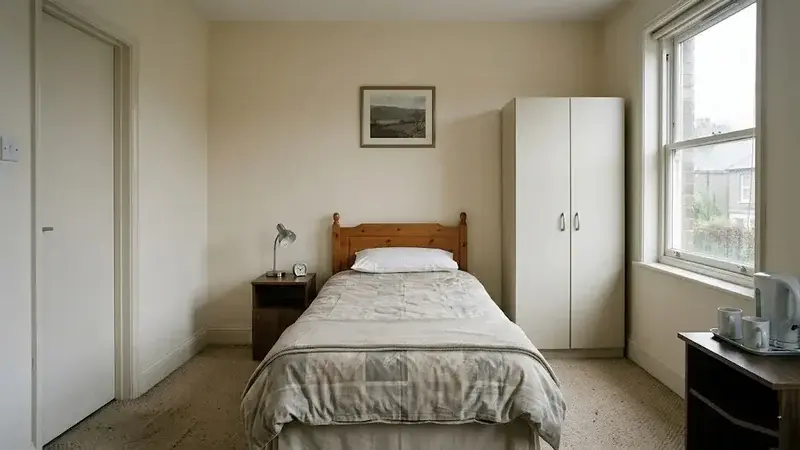
Here is a question most UK BnB and holiday let owners have never sat down to answer properly: how much is your room costing you per year by looking the way it currently looks?
Not the mortgage. Not the utility bills. Not the cleaning fee. Those are visible costs, and hosts account for them. The cost in question is invisible and rarely calculated — the gap between what your room currently earns per night and what it could earn, multiplied across every night of the booking season, compounded year after year.
For the majority of UK short-term rental hosts operating with an unstyled, generic bedroom, that gap is larger than they expect. In competitive coastal and countryside markets, it frequently runs to four figures annually. Over several years, it can exceed the value of many of the other investments a host makes in their property.
“The cost of a generic room is not a line item in your accounts. It is the absence of revenue that a distinctive room would have earned. That absence is invisible, which is precisely why most hosts never address it.”
This article is about making that invisible cost visible. Not to alarm, but to inform — because a cost you can see is a cost you can do something about. We will look at how guests make booking decisions, where the revenue gap comes from, how it compounds over time, and what the fastest and most cost-effective path to closing it actually looks like.
The UK holiday let market in 2026: what the numbers say
Before examining what a generic room costs, it is worth understanding the market environment in which that room is competing. Because the context matters: the gap between a well-presented and a poorly-presented listing is not fixed. It is shaped by how competitive the market around it is, and the UK short-term rental market in 2026 is considerably more competitive than it was five years ago.
According to the Sykes Holiday Cottages Holiday Letting Outlook Report 2025 — the most comprehensive annual analysis of the UK short-term rental sector — UK holiday let owners earned an average of £24,700 per property in 2024, with bookings growing 2.2% year-on-year. The market is not shrinking. But it is maturing: as supply grows and guests become more discerning, the gap between properties that stand out and those that do not is widening.
What these numbers mean in practice is that the market is growing in volume but also in competition. A guest searching for a coastal holiday let in Cornwall, Norfolk or Northumberland today has more choices than at any previous point. The properties that capture the premium bookings — the higher nightly rates, the better reviews, the returning guests — are not necessarily the most expensively furnished or the best located. They are the ones that give the guest a reason to choose them in the three seconds they spend looking at a search results grid on their phone.
A generic room, in that environment, is not neutral. It is a competitive disadvantage. And the cost of that disadvantage is measurable.
How guests actually decide what to pay
To understand where the revenue gap comes from, it helps to understand the guest's decision-making process — which is considerably less rational and deliberative than most hosts assume.
A guest browsing Airbnb or a holiday let platform for a weekend stay in a coastal destination is not conducting a detailed analysis. They are scrolling through a grid of thumbnail images, pausing briefly on anything that catches their attention, and clicking on the ones that create an immediate, positive impression. The decision to click — and the implicit decision about what that property might be worth — is made in seconds, before the guest has read the description, checked the amenities or looked at the reviews.
What creates that immediate positive impression is not price. It is not location. It is not even star rating, though all of these factors influence decisions further down the funnel. The trigger for the initial click — and the initial sense of what the property might be worth — is visual distinctiveness. The sense that this room is somewhere specific. That it has been thought about. That staying there would feel different from staying in the room next to it in the search results.
This is not an aesthetic preference or a niche market segment. It is how the majority of guests in the UK short-term rental market make their first booking decision, and research consistently supports it. The ONS data on UK short-term let bookings shows that guest nights in short-term rentals exceeded 90 million in 2024 — a market operating almost entirely through visual-first digital search. In that environment, the room photograph is not a supporting asset. It is the primary product.
The implication for pricing is direct: guests set their willingness to pay based on the visual impression formed before they have engaged with any other information about the property. A room that communicates distinctiveness — a coherent coastal theme, a clear visual identity, a sense of care — creates a higher willingness to pay than a room that communicates nothing in particular, even if the two rooms are functionally identical.
That differential in willingness to pay is the revenue gap. And it compounds.
The four places money leaks from a generic room
Most hosts, when they think about the cost of a generic room, focus on the nightly rate gap: the difference between what they charge and what a well-styled comparable property charges. That gap is real and significant. But it is only one of four distinct places where a generic room costs money. Understanding all four is important, because the full cost is considerably larger than the nightly rate gap alone suggests.
1. Lower nightly rates
The most direct cost. In competitive UK holiday let markets — coastal destinations like Cornwall, Devon, Dorset, Norfolk and Northumberland; countryside markets like the Cotswolds, the Lake District, the Yorkshire Dales and the Scottish Highlands — the premium that a well-styled, distinctively themed room commands over a comparable generic one is typically £10–20 per night.
This is not a claim about what hosts charge or what they think their rooms are worth. It is based on observable pricing differentials between comparable properties in the same markets, with the same bed sizes, the same locations and the same facilities — where the visible difference is the room's visual character. The styled room commands more. The generic room competes on price, which means competing downward.
2. Fewer bookings at any given price
A generic room does not just earn less per night. It earns less often. The click-through rate from search results — the proportion of times a listing is viewed that results in a booking enquiry — is meaningfully higher for visually distinctive listings than for generic ones. The guest who scrolls past a generic listing at £79 per night is not deciding it is too expensive. They are deciding, in the fraction of a second they spend looking at the thumbnail, that it is not interesting enough. The price never enters the calculation.
A room that generates more clicks at the same price has a higher effective occupancy rate. A higher occupancy rate at the same nightly rate generates more revenue. When combined with a higher nightly rate, the difference in annual income between a well-styled and a generic room can be considerably larger than the nightly rate gap alone implies.
3. Weaker reviews — and their downstream effects
Guests review what they remember. A generic room — comfortable, clean, functional, unremarkable — produces generic reviews. Four stars. “Nice room, clean and comfortable, friendly host.” These reviews are not damaging. But they are not doing work for the listing either. They do not differentiate it, they do not create desire in prospective guests, and they do not contribute to the momentum of a listing that consistently earns premium bookings.
A distinctive, well-styled room produces specific reviews. “The coastal décor was beautiful — we loved the fishing net and all the little details.” “The room felt like a proper seaside retreat.” “We took so many photos — everything matched and it felt really special.” These reviews do ongoing work for the listing. They tell future guests exactly what to expect and create anticipation rather than merely adequate expectations. They are also significantly more likely to earn five stars — because a room with a clear identity gives guests something to be enthusiastic about, not just satisfied with.
The downstream effect of stronger reviews — higher average scores, more detailed specific content, faster accumulation of social proof — is a further premium on what the listing can credibly charge.
4. No organic social sharing
A guest who stays in a distinctive, photogenic room photographs it. They post it to Instagram, share it in a WhatsApp group, tag the location. Each of those posts is free marketing — geographically relevant, from a real guest, reaching a real network. It costs the host nothing and drives awareness with exactly the audience most likely to book a similar property.
A generic room produces no such effect. Guests do not photograph anonymous spaces. They document memorable ones. The absence of organic social sharing is a marketing cost that is never invoiced and therefore never felt — but it is real, and it accumulates over every season that the room fails to create that impression.
The calculation: what it actually costs over time
With the four leakage points identified, it is possible to build a realistic picture of what a generic room costs annually — and over a typical hosting horizon.
The table below models a conservative scenario: a coastal or countryside holiday let room with 150 booked nights per year, where the nightly rate gap between the styled and unstyled version is £10 — at the lower end of what is typically observed in competitive UK markets. The model does not attempt to quantify the booking rate differential, the review strength differential or the organic social sharing differential. It counts only the nightly rate gap, which is the most conservative estimate of the true cost.
| Time period | At £10/night gap | At £15/night gap | At £20/night gap |
|---|---|---|---|
| 1 booking season (150 nights) | £1,500 | £2,250 | £3,000 |
| 2 years | £3,000 | £4,500 | £6,000 |
| 5 years | £7,500 | £11,250 | £15,000 |
| 10 years | £15,000 | £22,500 | £30,000 |
These are revenue figures, not profit figures. The investment required to close the gap — a coordinated room decoration kit, a listing photograph update, a rewritten description — is a fraction of the first year's improvement at any of these gap levels. The kit pays for itself in the first five to eight bookings at an improved nightly rate. Everything after that is incremental revenue the generic room was leaving on the table.
It is also worth noting what these figures do not include. They do not include the improvement in booking rate — which, at a conservative estimate, might add 10–15% more booked nights at the higher rate. They do not include the contribution of stronger reviews to sustained premium pricing over time. And they do not include the value of organic social sharing, which is impossible to quantify but consistently reported by hosts who have styled their rooms as a meaningful source of new bookings.
The true cost of a generic room, properly calculated, is almost always higher than the nightly rate gap alone suggests.
Why most hosts have not fixed this yet
If the cost is this significant, and the fix is this straightforward, why do the majority of UK BnB and holiday let rooms remain generic? There are three answers, and they are worth naming directly.
The cost is invisible
A missed booking does not generate a notification. A nightly rate that is £12 lower than it could be does not appear as a line item in any account. The guest who scrolled past the listing and chose a more distinctive property at £10 more per night does not send an email explaining their decision. The cost of a generic room is experienced only as the absence of revenue that was never quite achieved — and absences are extraordinarily difficult to respond to.
Visible costs — a broken boiler, a damaged piece of furniture, a bad review — demand attention because they present as problems. The generic room does not present as a problem. It functions. Guests book it, stay in it, leave it clean and occasionally leave adequate reviews. Everything is fine. The cost is entirely in what fine is not achieving.
The solution looks more complicated than it is
When hosts think about addressing the visual identity of a room, they often imagine a significant project: new furniture, fresh paint, an interior designer, a professional photographer, weeks of disruption. The return on that imagined project then gets weighed against other demands on their time and budget, and the decision gets deferred.
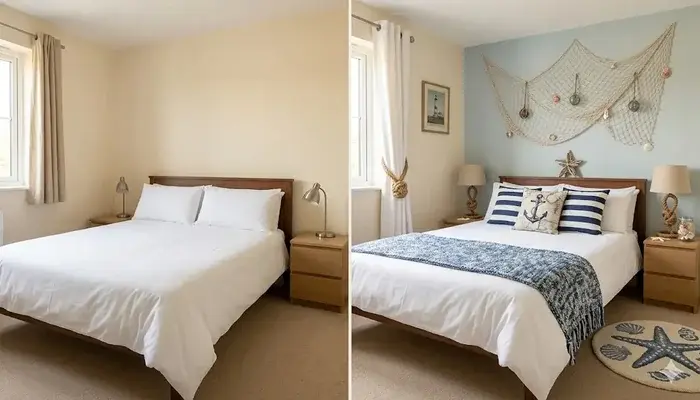
The reality is considerably simpler. A room's visual identity is determined not by its furniture or its walls, but by the layer of coordinated decorative elements that sit above those structural elements. A fishing net on the wall, four nautical cushion covers on the bed, a coastal rug beside it, a rope curtain tie-back and a wooden hanging sign create a coherent coastal identity in a room without touching a single piece of furniture or applying a single coat of paint. The work is an afternoon. The improvement is immediate and permanent. And as we cover in detail in our guide to styling a BnB room, it requires no design skills, no tools and no significant capital outlay.
The investment-return relationship is not obvious
A host who spends £79 on a room decoration kit is making a capital outlay that is visible and immediate. The return on that outlay — £10 more per night over 150 nights — is £1,500 in the first year, or a return of roughly 19 times the investment. But that return is not visible until bookings start coming in at the new rate, which requires updating the listing photograph first, and seeing improved click-through rates, which takes a few weeks to observe.
The psychology of investment decisions means that visible upfront costs weigh more heavily than future invisible returns, even when those returns are very favourable. This is why hosts who know, intellectually, that they should style their room often do not — the cost is certain and the return requires a step of faith based on a calculation that is easy to delay making.
Which is precisely why we have made that calculation explicit above. The numbers are not aspirational. They are conservative estimates of what the gap between a generic and a styled room costs, at the lower end of what is observed in UK markets.
The compound effect: why the gap grows over time
There is a further dimension to the hidden cost of a generic room that the simple nightly rate calculation does not capture: the compounding effect of reputation, reviews and repeat bookings.
A well-styled room earns better reviews. Better reviews earn more bookings at a higher rate. More bookings at a higher rate earn more reviews, faster. The cycle accelerates. After twelve to eighteen months, a property with a strong review profile and a distinctive identity can sustain a nightly rate that would have seemed ambitious when it started — because the social proof behind it has accumulated to the point where prospective guests have no reason to doubt it.
A generic room operates the opposite cycle. Adequate reviews sustain adequate bookings at adequate rates. The momentum is flat. There is no acceleration because there is nothing to accelerate. The room is fine, and fine compounds into year after year of fine — with the potential rate premium sitting just out of reach, never quite addressed.
This is why the timing of the decision to style a room matters. Every season that passes without addressing the visual identity of the room is a season without the compounding effect. The reviews not earned, the repeat guests not created, the organic social posts not generated — all of these represent future potential that was available and went uncaptured.
We cover the mechanism of this compounding effect in detail in our companion piece on five low-cost ways to increase your BnB nightly rate, including the timeline hosts can realistically expect when implementing the changes outlined below.
Closing the gap: what actually works
With the cost of the problem clearly established, the practical question is: what is the fastest, most cost-effective path to closing it? Based on what consistently works for UK BnB and holiday let hosts, the sequence is straightforward.
Choose a coherent theme and commit to it
Coastal, countryside, botanical, heritage — choose one direction that is natural to your location and introduce a small number of well-chosen, coordinated pieces. Eight coordinated pieces create a stronger impression than twenty unrelated objects. The wall, the bed and the floor are the three surfaces that matter most in terms of photographic impact. Address those three and the room's identity is established.
Update your listing photograph immediately
The photograph is what the improved nightly rate is built on. Once the room is styled, re-photograph it in natural daylight from a low corner angle, with the wall feature prominent. Update the listing cover image the same day. The improvement in click-through rate typically begins within the first week. We cover this in full in our guide to better Airbnb photos.
Rewrite the listing description around the experience
Features do not justify a premium. Experiences do. Rewrite your listing description to lead with what the room feels like — what the guest will see when they walk through the door, what the theme communicates, what makes this room different from the one next to it in search results. This costs nothing and takes an afternoon.
Increase the nightly rate and hold it
Once the room is styled and the photograph updated, increase the nightly rate. Not dramatically — £8–12 per night in the first instance is sufficient to test the market — but definitively. A well-styled room that charges the same rate as before the styling is leaving the investment on the table. The rate increase is what converts the improvement into revenue. Hold the new rate through the first month and allow the click-through data to confirm the improved position.
Prompt specific reviews and accumulate social proof
After each stay, send a follow-up message to guests that specifically references the room's themed elements and invites them to share their experience. Most guests who stay in a distinctive, characterful room are happy to describe it in a review — they just need the invitation. Those specific, detailed reviews are what sustain the premium nightly rate over time and build the compounding effect described above. For more on the role of star ratings in this process, see our guide to VisitEngland’s Sense of Place criteria.
What does not close the gap
It is equally important to name the interventions that do not reliably close the revenue gap, because they consume budget and attention that could be directed more effectively elsewhere.
New furniture rarely moves the needle on a generic room. Guests are not paying a premium for the age or quality of the wardrobe. A well-styled room with older furniture consistently outperforms a generic room with new furniture in both booking rate and nightly rate. The room's visual identity is created by the decorative layer, not the structural one.
Smart home technology is a legitimate amenity that some guests value. But it is not visible in a listing photograph and does not contribute to the visual distinctiveness that drives click-through rates and willingness to pay. It is a hygiene factor, not a differentiator.
Professional photography of an unstyled room is the most expensive common mistake in holiday let marketing. It produces high-quality documentation of an anonymous space. The photography cannot compensate for the absence of a visual identity — it can only record what is there. Style the room first, then photograph it. The order matters enormously.
Price reductions are the most common response to low bookings, and almost always the wrong one. A room that is not booking because of how it looks will not book more frequently because it is cheaper — it will book at a lower rate for guests who are choosing on price rather than character. The margin deteriorates without the underlying problem being addressed. The room still looks generic; it is now also cheaper.
The room you are not charging for
There is a version of your room that earns £10–20 more per night, books more consistently, generates specific enthusiastic reviews, and brings guests back for a second stay. That room is not in a better location. It does not have newer furniture. It has not been renovated. It has been given a story — a coherent visual identity that communicates, in the three seconds a guest spends looking at a thumbnail on their phone, that this is somewhere specific and worth paying for.
The gap between your current room and that version of it is not large. It is an afternoon's work, a small capital outlay and a listing photograph update. The return on that investment, calculated conservatively across a single booking season, runs to four figures. Calculated across the life of the property, it is one of the most favourable ROI decisions available to any UK BnB or holiday let host.
The cost of not making it is also calculated above. It is the difference between what the room earns and what it could earn, compounded across every night of every season, building into a gap that grows larger the longer it remains unaddressed.
That is the hidden cost of a generic room. Now you can see it.
Close the gap this weekend.
The KittedStay Coastal Kit — a coordinated set of coastal decorative pieces that give any BnB or holiday let room a distinctive identity in under 10 minutes. Aligned with VisitEngland, VisitWales and VisitScotland criteria. Delivered across the UK within 48 hours.
Get Your Kit from £79Frequently Asked Questions
The questions UK BnB and holiday let owners ask most often about room styling, nightly rates and the return on investment.
In competitive UK coastal and countryside markets, the typical premium for a well-styled, distinctively themed room over a comparable generic one is £10–20 per night. In premium locations and during peak season, the differential can be larger. In urban markets, where price sensitivity is generally higher, £8–15 is a more typical range.
The honest answer is that it depends on your market and your starting point. What is consistent is that the gap is almost always larger than hosts expect — because most hosts have never tested the ceiling of what their room can credibly charge when it has a clear visual identity and the listing photograph reflects that identity.
The practical approach is to style the room, update the listing photograph, increase the rate modestly (£8–12 per night to begin), and allow the data over the following four to six weeks to tell you where the new ceiling is. Most hosts find that their initial increase is sustainable and that there is room for a further adjustment after the first round of improved reviews comes in.
Yes, consistently and significantly. The relationship is not about decoration as a luxury or add-on — it is about what decoration communicates. A well-styled room with a coherent theme tells the guest that their stay has been thought about; that the host has put care into creating a distinctive experience rather than simply providing adequate accommodation. That perception of care carries directly into review scores and, more importantly, into the content of reviews.
Generic rooms generate generic reviews. Themed, distinctive rooms generate specific, enthusiastic reviews that describe particular details — the fishing net, the coastal cushions, the little touches that made the room feel deliberate. These specific reviews do more work for a listing than any marketing investment a host can make, because they come from real guests and carry the credibility of genuine experience.
VisitEngland, VisitWales and VisitScotland all formally assess Sense of Place as part of their star-rating criteria, which is a formal acknowledgement that the character and identity of a room contributes meaningfully to the quality of a guest's experience. Our guide to VisitEngland’s Sense of Place criteria covers this in detail.
No. This is the most common misconception about room styling, and it is the one that causes most hosts to delay making changes they know would improve their listing.
A room's visual identity is determined by its decorative layer, not its structural elements. Furniture, walls and floors are the backdrop — they are neutral surfaces that a coherent set of decorative pieces sits in front of. A fishing net on the wall, four nautical cushion covers on the bed, a coastal bedside rug, a rope curtain tie-back and a wooden hanging sign create a complete, coherent coastal identity in any bedroom, regardless of the furniture, the wall colour or the flooring beneath them.
Eight well-chosen, coordinated pieces will do more for your nightly rate than new furniture. Eight uncoordinated pieces accumulated over time will do nothing, regardless of their individual quality. Coordination matters more than cost, and a curated kit that is designed to work together creates a stronger impression than the same number of pieces sourced independently from different places.
The improvement in click-through rate — the number of guests clicking on your listing from search results — typically begins within the first week of updating the cover photograph. This is because the primary function of the listing photograph is to create that initial click, and a more distinctive image creates more clicks than a generic one, regardless of other factors.
The improvement in booking rate and average nightly rate typically becomes clear within four to six weeks, as the improved click-through translates into enquiries and bookings at the new rate. Within the first booking season — roughly three to four months after implementation — most hosts operating in competitive markets have more than recovered the cost of the styling investment.
The longer-term improvements — the accumulation of specific, positive reviews, the improved star-rating positioning, the repeat booking rate — take longer to compound, but they begin building from the first guests who stay in the improved room.
A coastal theme works best when it feels authentic to the location — and authentic does not require being directly on the coast. Properties within an hour of the coastline, or in any region with a strong maritime heritage, can carry a coastal theme convincingly. The UK has a very long coastline and a deep cultural association with seaside holidays, which means the theme resonates broadly with the guest market.
For properties in genuinely inland locations — the Cotswolds, the Yorkshire Dales, the Scottish Highlands — a countryside, botanical or heritage theme typically creates a more coherent identity. The principle is the same: one clear direction, a small number of well-chosen coordinated pieces, and a listing photograph that communicates the theme immediately at thumbnail size. The theme that works best is the one that feels natural to the location and is executed with coherence. Our guide to styling a BnB room covers how to choose the right theme for different property types.
A guest who takes a decorative piece as a souvenir is, perversely, a sign that the room made a strong impression. It is also a practical reality that any host operating a well-styled room will occasionally encounter.
The important thing is to replace missing pieces promptly. A room with a coherent theme that is missing one element photographs and presents differently from one that is complete — and if the missing piece is a prominent wall feature, the visual impact of the room diminishes meaningfully. Maintaining the room at its styled standard is part of maintaining the nightly rate that the styling supports.
Individual replacement pieces from the KittedStay Coastal Kit are available separately, so a missing piece can be replaced quickly and cost-effectively without purchasing the full kit again. See our FAQ page for details on ordering individual replacement pieces.